

In 2009, the UAE made a decision that reshaped how every private company pays its people. With the Wage Protection System (WPS) introduced by the Ministry of Human Resources and Emiratisation and the Central Bank of the UAE. Salaries can no longer be handed over in cash or paid as the employer wants. Wages had to move electronically on time, through approved channels that the government could actually monitor. More than sixteen years later, that single rule still sits.
This guide explains what payroll actually involves for a UAE business, how the monthly process works step by step, the obligations you cannot ignore and when to hire payroll outsourcing companies in dubai like payroll.ae for a smooth process.
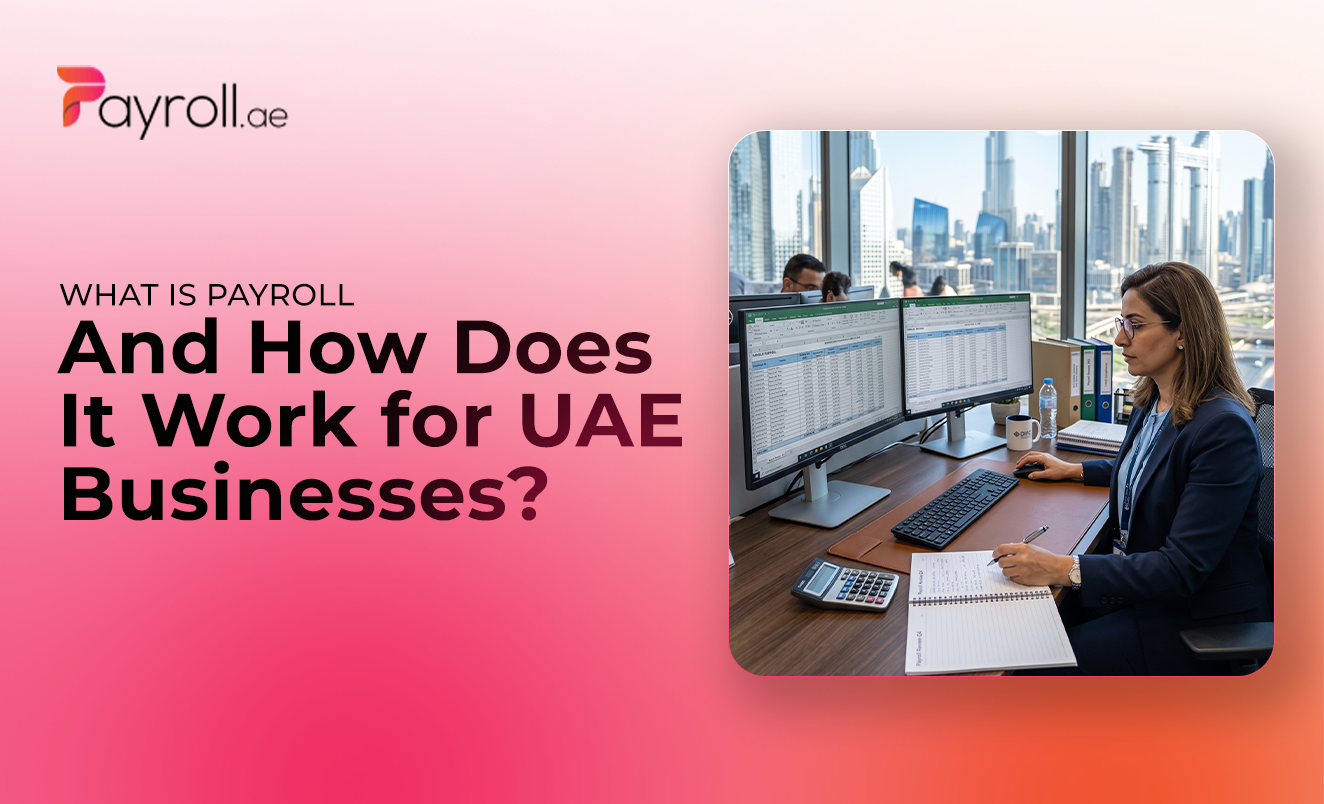
Payroll is the full process of calculating and paying what your employees earn then keeping accurate records of every dirham. It is far more than transferring a salary on the 28th of the month. A single pay run combines gross pay, allowances, deductions and the final net amount deposited into each bank account.
For most UAE companies, an employee’s package is split into a basic salary and a set of allowances such as housing, transport and other benefits. Payroll management has to handle each part correctly because that split affects more than just take-home pay. It gets directly into end-of-service gratuity which is calculated on basic salary and it shapes what appears in official records. Payroll also includes variable items each month, including overtime, unpaid leave, commissions and salary advances.
Beyond the numbers, payroll carries a compliance duty. Every business must generate payslips, retain records, transfer salaries through the WPS and account for obligations like pension contributions for UAE and GCC nationals. When people describe payroll as an administrative task they usually underestimate how many rules run underneath it. That is the reason payroll Dubai teams treat it as a compliance function first and a finance task second.
The payroll cycle repeats every month and follows a fairly consistent path whether you run it in-house or through one of the payroll outsourcing companies in Dubai. Each stage contributes to the next so an error early in the cycle usually shows up as a problem at the end.
A typical monthly run moves through these stages:
The WPS step is where UAE payroll is most different from other countries. Salaries are not simply sent by bank transfer. They move through a government-monitored system that matches what you pay against your registered workforce. This is also why timing matters so much. Wages are expected on the due date agreed in the employment contract and consistent late payment is treated as a compliance issue rather than a private matter between employer and employee. A reliable payroll process is built around that deadline, not around whenever cash flow feels comfortable.
This is where payroll stops being about spreadsheets and starts being about responsibility. Every private business has to pay its people correctly on time and in a way it can prove later and payroll is how a company demonstrates that month after month.
Free zones add another layer. Financial free zones such as the DIFC and ADGM operate their own employment frameworks so payroll rules there can differ particularly around end-of-service arrangements. A business with staff across the mainland and a free zone is effectively run by more than one rulebook. Because these obligations overlap with tax and audit requirements many companies coordinate payroll with their wider compliance work through a partner such as audit.ae so VAT and Corporate Tax records tell a consistent story.
Pro Tip: Structure the basic-salary-to-allowance split in your contracts deliberately and make sure it matches exactly what you report in the WPS. Because gratuity and pension are tied to basic salary, an inconsistent or last-minute split can inflate your future liabilities or create mismatches during a labour or tax review.
The honest comparison depends on your size, complexity and appetite for managing compliance internally.
The table below sets out the practical trade-offs.
| Factor | In-House Payroll | Outsourced Payroll |
| Compliance responsibility | Sits entirely with your team | Managed by specialists who track WPS and labour changes |
| Setup cost | Software, training, and staff time | Fixed monthly fee, no infrastructure to build |
| Accuracy and checks | Depends on internal expertise | Built-in reviews reduce common errors |
| Confidentiality | Salary data visible to internal staff | Handled externally and kept private |
| Scalability | Needs rework as you grow | Adjusts easily with headcount changes |
| Best suited to | Small, stable teams | Growing or multi-entity businesses |
The deciding question is usually not cost alone but risk. If a payroll error or a missed WPS deadline would seriously disrupt your business the case for outsourcing to an experienced provider becomes much stronger.
Not every provider offers the same standard so the selection matters as much as the decision to outsource. Start with compliance credibility. The provider should understand WPS submission through approved agents, gratuity calculations and pension obligations for national employees. If they cannot explain these clearly they are not the right fit.
Data security is the next priority because you are handing over sensitive salary and personal information every month. Ask how records are stored, who can access them and how payslips are delivered. Transparent pricing matters too so you know whether services like final settlements, corrections, and reporting are included or billed separately. It also helps to choose a partner that connects payroll with wider financial services. Finally look for a team that scales with you and responds quickly since payroll problems are always urgent when a salary is involved.
For most UAE businesses, the right choice is a provider that treats payroll as a compliance service rather than a simple transfer. That is the standard that payroll.ae is built around and it is what separates a genuine partner from a basic processor.
Payroll in the UAE is far more than paying salaries on time. It is a monthly compliance cycle shaped by the Wage Protection System with free zones adding their own requirements on top. Handled carefully it protects your employees, your records and your standing with the authorities. Handled carelessly it creates a risk you do not need.
That is why so many companies rely on payroll outsourcing companies in Dubai to run the process accurately and stay compliant as they grow. Whether you keep payroll in-house or outsource it, the goal is the same: get every employee paid correctly and on time, keep clean records and stay ahead of the rules. If you want payroll managed by a team that treats compliance as the priority, payroll.ae can help you build a process that holds up under proper checks.
Everything you need to know — answered.
UAE payroll is the employer’s process of calculating gross pay, applying lawful deductions and paying employees in the UAE.
Manual Payroll, In-House Payroll, and Outsourced Payroll.
The four basic steps are: doing the prep work, collecting timesheet data, calculating gross pay, and determining deductions.
Payroll is normally connected with payments, wage or salary calculations, overtime, creating payslips, and payroll tax withholdings. HR, on the other hand, deals with recruiting and hiring, managing employees, employee relations, and managing the overall workforce.